

Inside Crypto Venture Capital: Trust, Tokens and a $200,000 Deal
An Introduction to How Crypto Venture Capital Works.
It is winter 2021. I am sitting in front of my laptop, observing an online meeting between a crypto venture investor and a blockchain project. The conversation lasts about twenty minutes. Afterward, the investor transfers $200,000 to the project. The entire decision-making process has taken only a few days. The investors have reviewed the pitch deck, discussed the opportunity within their community on Discord, and decided that they believe in the idea. They have never met the founders in person. They do not know them personally. Yet they are prepared to back their vision.
This was one example of the fast-moving, community driven side of crypto venture capital that I encountered. It reminded me of the old image of financial dealmaking built around a handshake: people placing considerable weight on trust, reputation and a shared belief in an opportunity. Except here, there was not even a physical handshake. I am not suggesting that every crypto investor operated this way, or that trust made contracts unnecessary. What struck me was how much of the investment relationship could develop online, and how quickly conviction could turn into a substantial financial commitment.
That experience raises a broader question: what exactly is crypto venture capital, and why should we distinguish it from traditional venture capital? Drawing on my years in the industry and my ongoing research into crypto venture capital, I want to explain the main organizational forms, how investors obtain returns, and what happens between the first pitch deck and the transfer of funds.
What Is Crypto Venture Capital?
At its simplest, crypto venture capital is organized investment in young blockchain or token based ventures, accompanied by activities such as evaluating projects, structuring investments, providing advice, opening networks or supporting their development. The investor might be a conventional VC firm, a specialist crypto fund or an investment community. Simply buying an already traded cryptocurrency does not, by itself, make someone a venture capitalist.
But why give it a separate label? Sector specialization alone is not unusual. Investors can focus on artificial intelligence, healthcare or financial technology while retaining a familiar venture-capital structure. Crypto deserves particular attention because it can change not only what investors finance, but also what they own, who makes decisions and how they eventually realize returns. Company shares may coexist with tokens; investment committees may coexist with community voting; and a token may become tradable while the underlying venture remains at an early stage.
Not every crypto investment uses all these features. An equity investment in a blockchain company can look much like an investment in another technology startup. The important point is that crypto introduces additional structures and possibilities, not that it replaces every established investment practice.
Who Are the Investors?
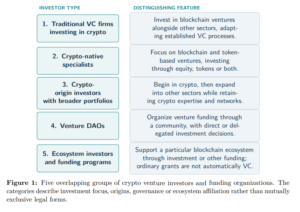
There is no single organizational model. For an introductory overview, I find it useful to distinguish five broad groups, while recognizing that they overlap.
Traditional VC firms investing in crypto finance blockchain ventures alongside businesses in other sectors. They may apply an established investment process while adapting their expertise and contractual terms to the project. Crypto-native specialists focus on blockchain and token based ventures. Their specialization can include knowledge of protocols, token design, developer communities, governance and crypto market liquidity. They may invest through equity, tokens or a combination of both.
I also distinguish crypto origin investors with broader portfolios, investors that began in crypto but subsequently expanded into other sectors. They retain their crypto experience and networks without necessarily remaining crypto only investors. This is one reason a simple division between “traditional” and “crypto” funds does not always capture how an organization actually operates.
Venture DAOs provide another model. A decentralized autonomous organization, or DAO, can organize investment through a community rather than relying exclusively on a conventional fund management team. Members may pool capital, discuss opportunities and vote on investments or treasury decisions. Some arrangements use direct voting; others delegate decisions to selected members or teams. Importantly, a DAO only belongs in this category when it actually finances or supports ventures not merely because it has a community and a voting token.
Finally, ecosystem investors and funding programs support projects building within a particular blockchain ecosystem. Their objective may include financial returns, but also attracting developers, improving infrastructure and encouraging adoption. For example, the Solana Foundation provides grants and convertible grants for projects that contribute to its ecosystem. A distinction matters here: an ordinary grant is not automatically a venture capital investment. Ecosystem support can combine commercial investment with other forms of funding.
These are useful ways to understand the participants, rather than five mutually exclusive legal categories. A specialist investor might manage an ecosystem focused fund, while a venture DAO might co-invest with a conventional VC.
Where Does Their Money Come From?
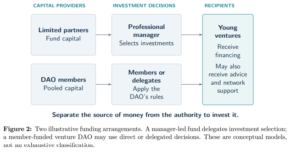
Some crypto funds follow the familiar venture-capital model: they raise capital from limited partners, or LPs, and a professional management team selects investments on their behalf. LPs obtain exposure to the sector while delegating investment selection and management. A crypto mandate does not necessarily change that basic arrangement.
Other arrangements are funded by the participants themselves. Angel investors may combine their own money and expertise to invest collectively. In a member funded venture DAO, the people contributing capital may also participate in deciding how it is deployed, rather than delegating all investment authority to a separate manager. The degree of participation depends on the organization’s rules.
The key is to separate two questions: who provides the capital, and who decides where it goes?
The First Major Difference: What Investors Own and How They Exit
In traditional venture capital, investors typically obtain an equity interest in a company. They aim to support its development and eventually realize returns through an acquisition, an initial public offering, or a secondary sale of their shares. An IPO is an important milestone, but it does not automatically mean every early investor has made a profit. What ultimately matters is the value investors actually receive relative to what they invested.
Crypto investors can use these conventional routes too. Acquisitions are certainly not absent from the industry: Coinbase, for example, announced the completion of its acquisition of Deribit on August 14, 2025. The distinctive additional route is token based liquidity.
In a pure-token investment, the investor receives tokens or a contractual right to receive them later, rather than shares in the operating company. Other deals combine equity with token rights. These are different claims: owning tokens does not automatically provide company ownership, dividends, a board seat or the protections associated with preferred shares. The rights depend on the token’s design and the accompanying agreements.
The attraction is that tokens may become tradable before the company or project reaches the maturity associated with a conventional corporate exit. But that possibility introduces an important distinction: a token can reach the market before the venture has demonstrated that it can build something sustainable.
Centralized and Decentralized Exchanges
Token trading can take place on centralized exchanges, commonly called CEXs, or decentralized exchanges, commonly called DEXs. A centralized exchange operates a platform and decides which assets it will support. Its listing process can involve substantial review. Coinbase, for example, describes checks covering technical security, compliance and legal considerations. It would therefore be wrong to assume that a major exchange listing involves no scrutiny.
A permissionless decentralized exchange works differently. On protocols such as Uniswap, participants can create markets and provide liquidity without going through a conventional centralized listing committee. That accessibility is one reason the existence of a trading market should not be mistaken for an independent endorsement of a project’s quality.
Neither process should be confused with taking a company public through an IPO. An IPO concerns a company’s first public offering of shares; making a token tradable need not involve offering shares in the operating company at all.
The terminology also needs care. An ICO, or initial coin offering, is a token-fundraising mechanism. An IDO, or initial DEX offering, uses a decentralized exchange or associated launchpad. An IEO, or initial exchange offering, is conducted through a centralized exchange. These describe offering arrangements not every subsequent exchange listing, and not necessarily an exit for an existing investor.
A Listing Is Not a Realized Return
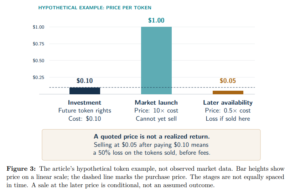
This is one of the most important points in the entire discussion. A project’s token may begin trading at an impressive price, but early investors may not be able to sell their full allocation. Their agreements may include an initial lockup followed by a vesting schedule that releases tokens gradually. By the time a substantial portion becomes available, the price may have fallen below their purchase price.
Consider a simple hypothetical example. An investor buys future tokens at $0.10 each. The token launches at $1, suggesting a tenfold increase in value. But the investor cannot sell at that point. If the tokens later become available when the market price is $0.05, that spectacular launch price has not delivered a profit.
The same caution applies to the venture itself. A listing, a high valuation and active trading do not necessarily demonstrate durable demand, sound governance or a sustainable business. My research therefore distinguishes token liquidity, investor returns and successful venture development rather than treating them as interchangeable outcomes.
The Second Major Difference: How Due Diligence Works
The familiar picture of venture investing involves reviewing numerous opportunities, examining the team and business, checking information and building confidence before committing capital. Crypto does not remove those tasks. It adds new objects of investigation and different ways of obtaining information.
My opening story illustrates one end of the spectrum: a brief call, a small number of discussions and a rapid decision. During the heated market conditions I experienced, some projects attracted more investor interest than they needed. In those situations, founders could choose whose money to accept. Investors were not simply asking whether a project deserved funding; they were also trying to secure a place in the round. That could create pressure to move quickly. Some investors appeared reluctant to prolong discussions or ask difficult questions because they feared losing the allocation.
I have also seen the opposite: projects working much harder to attract funding, while investors have more time and bargaining power. These are changes in market conditions, rather than permanent characteristics of every crypto deal.
It would be misleading, however, to conclude that professional crypto due diligence normally consists of a twenty minute conversation. One interview study covered in my review reported processes ranging from three to five days at some investors to as long as 180 days at others. Although the sample was small, it illustrates the variation hidden behind the label “crypto VC.”
Investigating More Than a Pitch Deck
For a software-based blockchain project, reviewing the code, protocol design and security can be central to understanding the investment. Investors also need to examine the team, commercial logic, token economics and regulatory exposure. An impressive technical presentation does not eliminate the need to understand who will use the product and why.
Community assessment is another important component. A project’s community may include its users, developers, contributors and future governance participants. But a large Discord server or social-media following is not necessarily evidence of genuine adoption. Activity may reflect promotional campaigns, automated accounts or temporary rewards rather than lasting interest in the product.
Much of this investigation can happen online. Investors can review repositories, follow governance discussions, inspect blockchain activity and conduct repeated calls with founders. In-person meetings at conferences or elsewhere can help build relationships, but the location of a meeting is not, by itself, a measure of the quality of the diligence.
The important distinction is not physical versus digital. It is informed judgment versus an untested story.
The Third Difference: Contracts and the Transfer of Funds
Once an investment has been agreed, the mechanics of completing it may also look different. In the crypto-native transactions I am describing, funding can move directly between digital wallets, often using stablecoins rather than a conventional bank transfer. Stablecoins are designed to maintain a stable reference value; for example, Circle describes USDC as designed to maintain a one-to-one value with the US dollar. The chosen payment asset and settlement arrangements depend on the deal.
But the asset used to pay for an investment should not be confused with the claim the investor receives. Paying with a digital asset does not, by itself, establish whether the investor is purchasing equity, tokens or contractual rights.
Two terms commonly arise in these discussions. A SAFT (Simple Agreement for Future Tokens) provides contractual rights to future tokens under specified conditions. It is not the same thing as receiving freely tradable tokens immediately. The agreement matters because it sets out what the investor is entitled to receive and the circumstances governing delivery.
A SAFT (Simple Agreement for Future Tokens) provides rights relating to future company equity, usually converting into shares when a specified financing event occurs. It is not a token agreement. Hybrid investments may combine an equity instrument with a separate token warrant or other token entitlement. Neither document is universal, and neither acronym is a substitute for understanding the actual terms.
This also brings us back to trust. An investment may begin with a conversation in a community channel, but that does not make legal rights irrelevant. Nor is “unregulated” a reliable description of the entire industry. The European Union’s Markets in Crypto Assets framework, for example, establishes rules covering specified crypto-assets and service providers. Which obligations apply depends on the activity, asset and jurisdiction.
Trust may help people decide to work together. Clear agreements determine what they have actually agreed to do.
What That Twenty-Minute Meeting Taught Me
Looking back, the most interesting part of that winter 2021 meeting was not simply the speed or the amount of money. It was the combination: a remotely assessed project, an investment community discussing the opportunity on Discord, and a substantial commitment made without an in person relationship.
For me, that captures both the appeal and the vulnerability of this corner of venture finance. People could find one another, share a vision and mobilize capital quickly. Yet the ease of making the investment did not resolve the much harder questions about execution, accountability and long-term value.
My research leads to a similar conclusion. Crypto venture capital retains familiar functions selecting ventures, structuring claims, supporting development and seeking returns but adapts them to tokens, digital communities and new governance arrangements. It changes how venture finance operates without eliminating the need for judgment and discipline.
For an introductory post, that is the distinction I would leave readers with: crypto venture capital is not simply traditional VC investing in a different industry. But neither is it a shortcut around the fundamental challenge of backing people who can build something valuable.